Onekoshima
Onekoshima is a virtual cat island built around oneko.js, the tiny pixel cat that runs after your mouse cursor. It combines an archive of more than 500 community-made sprite sheets with playable cats, a sprite design tool, GeoCities-era GIFs, archived Neko software, and decades of cursor-cat history.
Visit Website ↗A look inside Onekoshima
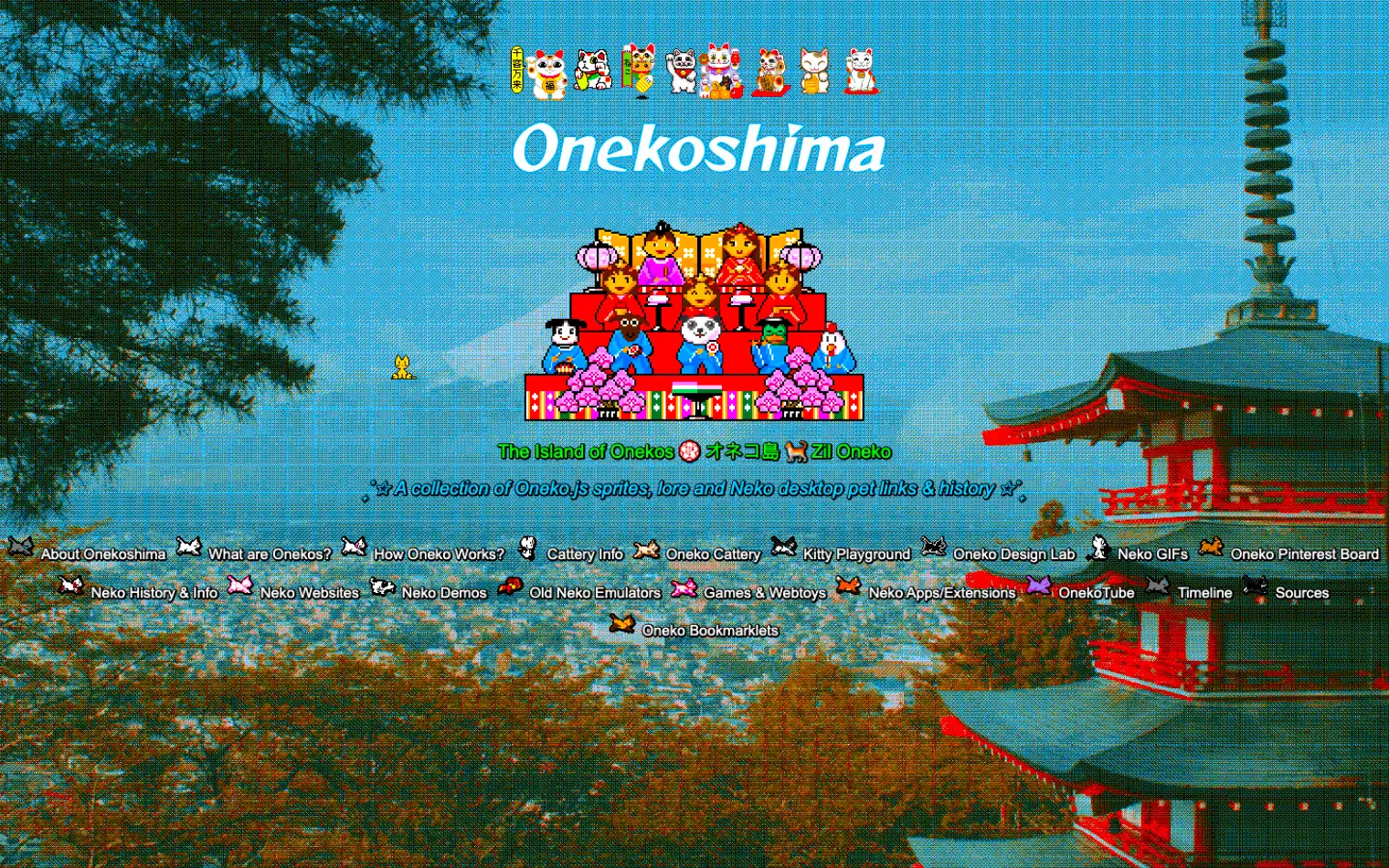
At a glance
- Experience
- Exploration
- Mood
- Playful
- Interaction
- Browse + play
- Best for
- Pixel-art and old-web rabbit holes
- Collection
- Retro Websites
What is Onekoshima?
Onekoshima is part archive, part playground, and part digital museum for Oneko and its much older Neko family tree. Creator Vijay Shah began gathering oneko.js sprite sheets for another web project before giving the collection its own site in 2026.
At its center is oneko.js, a small JavaScript script created by adryd/Ari that places an animated character on a webpage and makes it follow the mouse. Onekoshima expands that simple idea into a much larger collection of sprites, software, GIFs, experiments, and historical material tracing how cursor-chasing desktop pets moved from old computers onto the personal web.
What happens when you visit?
The homepage works like a directory for the island, with paths into the Cattery, Playground, Design Lab, GIF archive, software history, and collections of related projects. The Cattery is the largest section: more than 500 sprite sheets arranged alphabetically, with cats mixed alongside dogs, foxes, game characters, objects, vehicles, and other remixes.
The Playground releases random Onekos to chase your cursor, lets you drag them around, or allows you to spawn a particular sprite. In the Design Lab, you can recolor or texture the classic sprite sheet, change its speed, test the resulting character as it runs after your mouse, and download the finished PNG.
Further in, the site becomes a broader Neko rabbit hole. There are animated GIFs recovered from GeoCities through GifCities, links to old software and archived pages, browser demos, playable emulations, games, apps, videos, bookmarklets, and a timeline connecting today's web cats with older desktop versions.
What makes it weird or unusual?
Onekoshima takes one tiny cursor-chasing creature and gives it the treatment of an entire digital ecosystem. Instead of simply demonstrating oneko.js, it catalogues hundreds of mutations of the same basic sprite format and then surrounds them with tools, games, archived software, and historical ephemera.
The stranger part is how many eras of computing meet in the same place. A modern JavaScript cursor cat leads backward into GeoCities GIFs, Macintosh desktop accessories, X11 and Unix software, Windows shareware, and decades of community-made pixel art. The retro material is not just styling around the site; it is what the site is actually collecting.
Why is it on OpenWeird?
Onekoshima preserves a wonderfully unnecessary branch of computer culture: little animated companions whose main purpose was to make a screen feel less sterile. Its combination of cursor interaction, pixel art, community remixing, and old-web archaeology makes it both something to play with and a record of the handmade internet that produced things simply because somebody thought a tiny running cat would be fun.
Enter Onekoshima
KEEP WANDERING
Leave this rabbit hole behind and let the portal choose another strange corner of the web.